Web1 to Web3: You've got (new generation) mail

Email platforms have been a staple of online communication since the early days of the Internet, but the technology has come a long way from its humble beginnings in Web1. Remember those plain text emails that lacked any real visual appeal? Well, things have changed! With the arrival of Web2, email platforms started offering features such as embedded images, HTML formatting, and even video messages. Suddenly, your inbox became a lot more interesting, and email became a more engaging form of communication.
But the evolution of email didn't stop there. With the advent of Web3, email has become even more innovative and decentralized. Imagine having an email account fully encrypted and protected from cyber threats and where you can control your data, assets, and digital identity. That's the future of email on Web3.
Web1 origins: Limited features
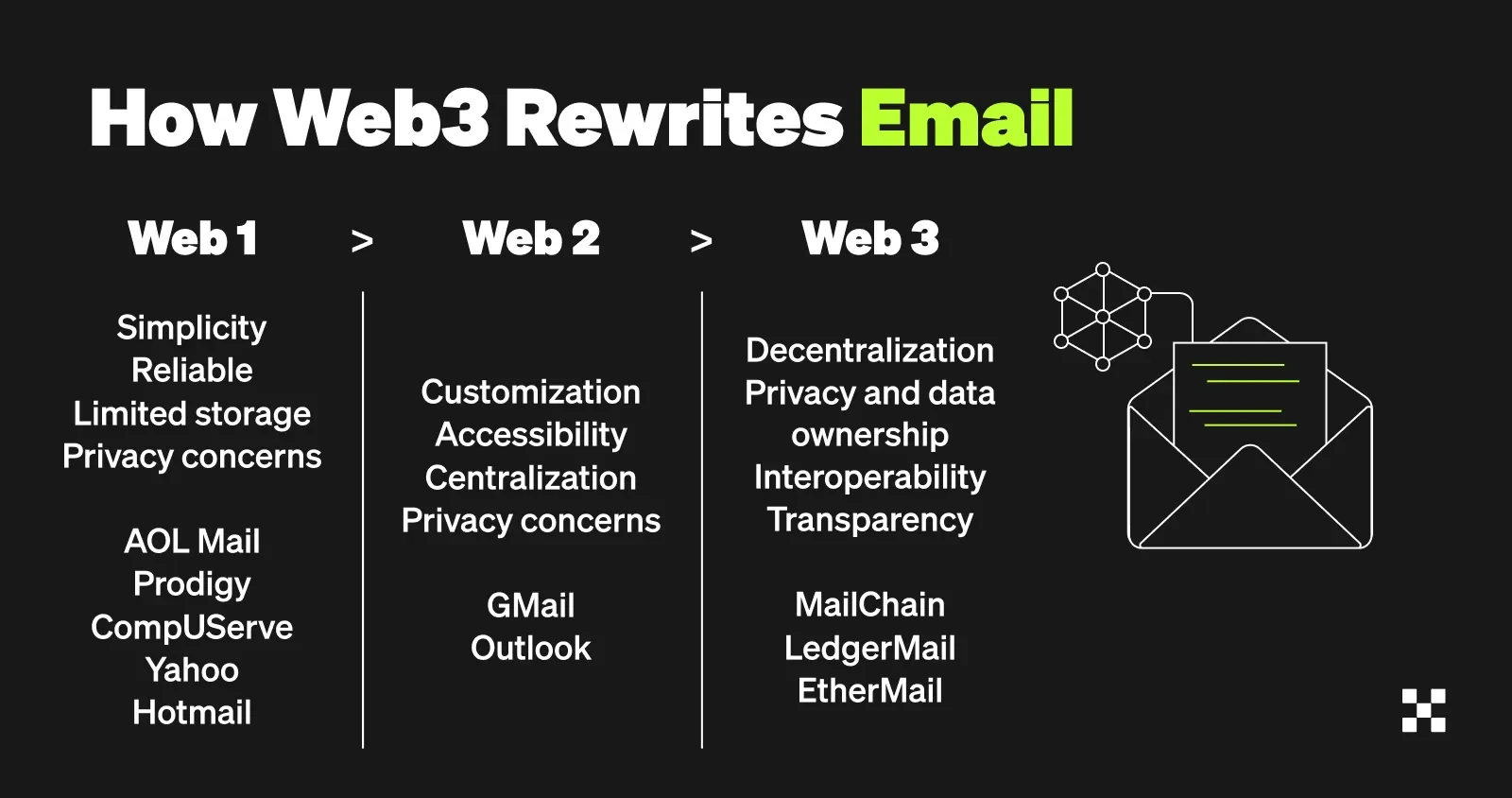
Email was a new and exciting (if very basic) communication method when it arrived in the Web1 era. But platforms were limited in their safety and security. What's more, there were only a handful of free email platforms available, while the rest charged a fee either per email or for a monthly subscription to a service provider.
AOL Mail: In the early 1990s, AOL emerged as one of the leading internet service providers. The company's catchy "You've Got Mail" chime became instantly recognizable, and its email platform offered a simple user interface that helped boost its popularity. For countless users, AOL was their first experience with email as a means of communication. However, it wasn't free. You had to pay a monthly subscription, similar to other internet providers like Prodigy and CompUServe.
Hotmail: Launched in 1996, Hotmail was one of the first free email services available to the public. It was later acquired by Microsoft and rebranded as Outlook.com.
Yahoo! Mail: Yahoo! was one of the earliest search engines and web portals. The company began offering email services to its users in 1997.
The Web2 transition: Free, but you're the product
Web2 email platforms have made communication more accessible and user-friendly. With features like web-based interfaces, spam filters, and unlimited storage, users can keep all their important messages in one place. Plus, many platforms offer mobile apps for on-the-go access. Email remains a cornerstone of modern communication for individuals and businesses alike. The vast majority of email platforms are free to use today, but that doesn't mean there's no profit involved. Rather, users are the 'product', as email providers sell user data to third parties.
Gmail: Launched in 2004 by Google, Gmail is one of the most popular email platforms worldwide. It offers many features such as storage, search, labels, and integration with other Google services.
Outlook: Outlook is Microsoft's email platform, the successor to Hotmail. It offers a clean and simple interface and integration with other Microsoft services such as OneDrive and Skype.
ProtonMail: ProtonMail is a secure email platform offering end-to-end email encryption. It is popular among users who prioritize security and privacy. While it's not a Web3 email platform, it is popular with crypto natives and Web3 projects because of encryption and privacy.
Web3's future: Private, decentralized email
As we move into the Web3 era, email is set to become more decentralized and secure. Web3 email platforms will prioritize end-to-end encrypted email services designed to protect user privacy and security. In addition, by leveraging decentralized technologies such as blockchain and peer-to-peer networking, these platforms will make it harder for hackers and third-party entities to access user data. As a result, email will become a more trusted and secure means of communication in the Web3 ecosystem.
Mailchain: Mailchain is an email protocol that uses blockchain technology to create a decentralized email system. It allows users to send and receive emails using their own blockchain wallets, offering high security and privacy.
LedgerMail: LedgerMail is a decentralized email platform that takes encryption seriously with its cryptographic algorithms and hashing functions. The service doesn't believe in centralized governance and uses asymmetric cryptography to enhance user privacy.
EtherMail: EtherMail offers end-to-end encryption, blockchain-based identity management, and secure attachment storage. It also allows users to store, manage and control access to their own email data. The service is available for free and can be accessed through a web browser or the Ethereum wallet app.
A medium ripe for disruption
As a major medium for the exchange of information and data, email is ripe for disruption from the powers of Web3. Tomorrow's email platforms will not only emphasise privacy and security, they'll give users greater control over how their data is used and accessed.
Get into Web3 today
Feeling inspired? OKX is your portal into Web3. Jump in today.
NOTHING IN THIS ARTICLE IS A SOLICITATION TO BUY OR SELL DIGITAL ASSETS. OKX DOES NOT ENDORSE ANY PARTICULAR DIGITAL ASSET OR STRATEGY. DIGITAL ASSETS HOLDINGS INVOLVE A HIGH DEGREE OF RISK, CAN FLUCTUATE GREATLY ON ANY GIVEN DAY, AND MAY EVEN BECOME WORTHLESS. YOU SHOULD CAREFULLY CONSIDER WHETHER TRADING OR HOLDING DIGITAL CURRENCIES IS SUITABLE FOR YOU IN LIGHT OF YOUR FINANCIAL CONDITION. OKX DOES NOT PROVIDE LEGAL, TAX, INVESTMENT, OR OTHER ADVICE. PLEASE CONSULT YOUR LEGAL/TAX/INVESTMENT PROFESSIONAL FOR QUESTIONS ABOUT YOUR SPECIFIC CIRCUMSTANCES.